
Best Facebook Ads Tools for 2026: 7 Options Compared
Compare the best Facebook ads tools for agencies, freelancers and in-house teams, with pros, cons, pricing signals and audit-trail features.
A media buyer opens the day to find an underperforming Meta ad across a dozen client accounts. The important question isn’t only what went wrong. It’s how quickly someone can act, what the tool is allowed to change, and who can prove what happened afterward. A dashboard may flag rising CPA, but a buyer still has to decide whether to pause an ad, move budget, launch a replacement, or leave the account alone.
That’s the standard used here. These are the best Facebook ads tools by the job they do, including management, creative production, optimization, and reporting, and by who runs them, from agencies and freelancers to in-house teams. The comparison also treats write scope and audit trails as core buying criteria, not optional extras. Your DTC Facebook ad copy strategies still matter, but execution discipline determines whether good creative survives contact with the auction.
Table of Contents
- 1. AdCrunch
- 2. Birch, formerly Revealbot
- 3. Madgicx
- 4. AdEspresso by Hootsuite
- 5. Smartly.io
- 6. Skai, formerly Kenshoo
- 7. Sprinklr Advertising
- Top 7 Facebook Ads Tools Comparison
- Matching a Facebook Ads Tool to Your Team
1. AdCrunch
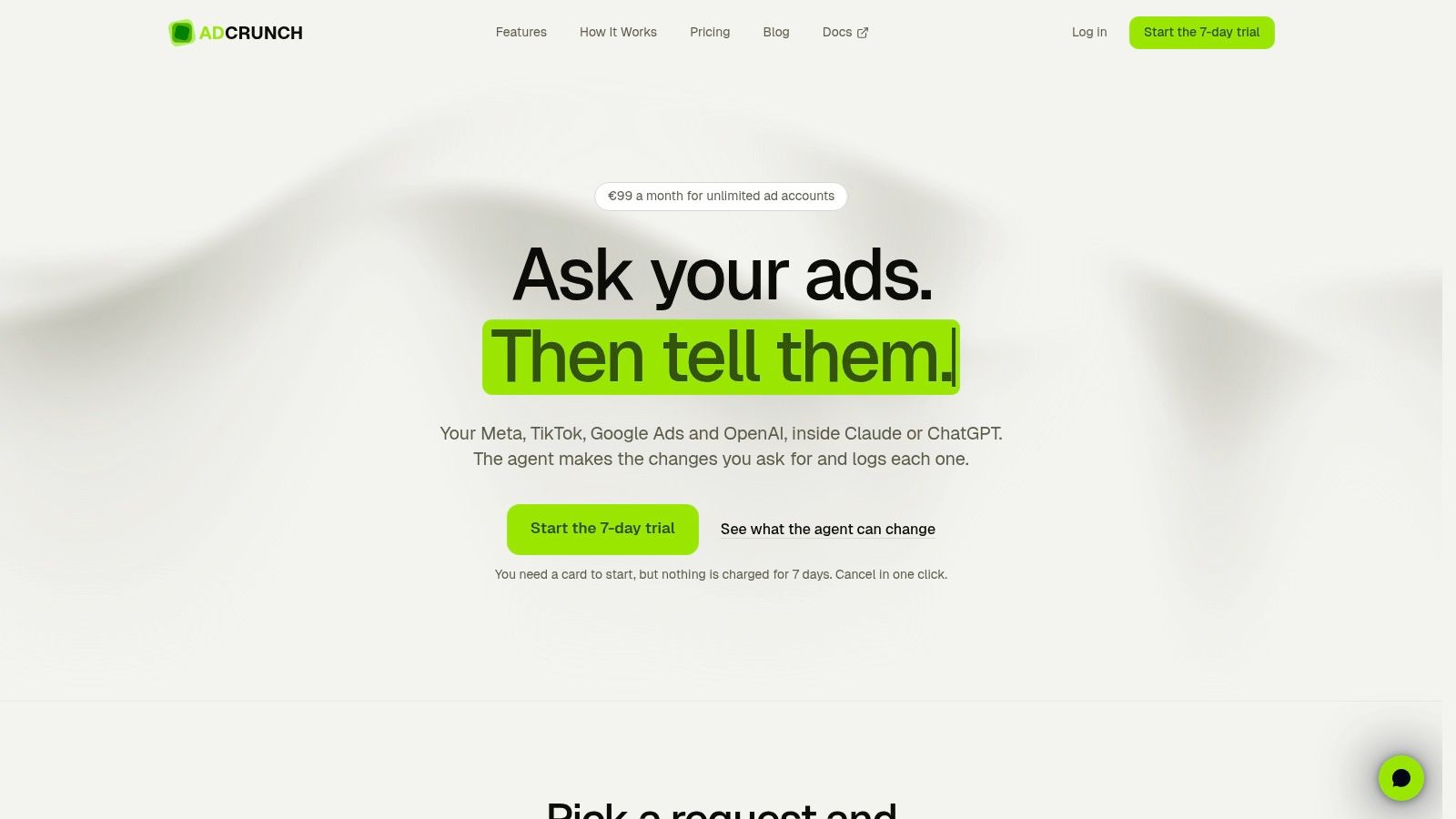
AdCrunch fits teams where the gap between diagnosis and action is costing time. It connects Meta, TikTok, and Google Ads to agents in Claude, ChatGPT, Cursor, or its built-in Adgent. A buyer can ask a cross-account performance question, then move into a controlled Meta action without switching between separate tools.
Its scope extends beyond reporting. On Meta, AdCrunch can create campaigns, ad sets, creatives, and ads; adjust daily or lifetime budgets; pause, resume, archive, and copy entities. New creations start paused, hard deletes are not supported, and existing ad sets cannot have their targeting changed. These limits reduce the chance that a fast workflow creates unintended spend.
Why the activity log matters
Every operation appears on a permanent Activity page with the account, request origin, change details, and outcome. Agencies can see who requested a budget change, what the agent attempted, and whether Meta accepted it. That record also helps troubleshoot accounts handled by several buyers.
Skills and Brands hold playbooks and brand guidance. Campaign Plans turn structured instructions into executable work while keeping the plan aligned with the launch. For example, a team could identify ads above a chosen CPA threshold, pause them, shift budget under an approved plan, and retain each action for review.
Operational rule: A tool should shorten the path from diagnosis to controlled action while keeping responsibility visible.
The Pro plan costs €99 per month with unlimited ad accounts and seats. A 7-day free trial requires a card but charges nothing during the trial. Enterprise adds SSO, SLA support, and custom integrations. AdCrunch stores platform credentials and runs API calls server-side, while connected AI models do not receive raw tokens.
Best for: Performance agencies, freelance media buyers, ecommerce teams, and multi-brand in-house teams.
Trade-offs: Meta is currently the write-enabled network. TikTok and Google are read-only, so teams requiring write access across every channel may prefer native tools or another platform.
2. Birch, formerly Revealbot
Birch is the better choice for buyers who want explicit, rules-based control. It’s a mature automation platform for Meta, Google, TikTok, and Snapchat, with a workflow built around conditions that the operator defines and maintains.
A typical Birch rule might watch spend, CPA, frequency, or another custom metric over a selected timeframe, then pause an ad, adjust a budget, or send an alert. That logic is clear. You can inspect the rule, understand why it fired, and adapt it when the account strategy changes. For agencies, that’s often preferable to an opaque optimizer that makes changes without showing its reasoning.
Where Birch earns its place
Bulk launch and iteration tools help teams create and test variations across connected accounts. Explorer supports structured testing, while scheduled reports, Slack alerts, and Sheets integrations keep clients and buyers informed without requiring everyone to work inside the platform.
Its activity log and account overview are useful for operational review, although the exact audit requirements should still be checked against your approval and compliance process.
Best for: Agencies and experienced performance teams with repeatable optimization playbooks.
Trade-offs: Pricing is tied to monthly ad spend, so the bill can rise as accounts scale. Birch also isn’t a creative production suite. It complements a design, feed, or creative testing workflow rather than replacing one.
The main risk is configuration quality. A flexible rule engine can scale a sound process, but it can also scale a badly designed one. Start with narrow actions, clear thresholds, and a review process before allowing broad automated changes.
3. Madgicx
Madgicx is built for teams that want deep Meta-specific analysis around audiences, creative, and budget movement. It combines automation rules with audience and creative insights, then adds server-to-server tracking options for teams trying to improve the signal available for attribution.
The platform suits ecommerce operators and agencies that spend most of their time inside Meta rather than needing a broad cross-channel command center. Budget shifting across campaigns and ad sets is a central use case, while client-facing reports and shareable views help agencies explain performance without giving every client access to the working account.
For a buyer, the appeal is depth. Madgicx can expose patterns that are easy to miss in a standard account review, especially when creative performance and audience quality need to be considered together. The limitation is that the tool still needs a clear measurement framework. A dashboard can show platform-attributed ROAS, but it can’t by itself prove that every reported conversion was incremental.
Check the commercial details closely
Pricing and billing can feel complex, so review the plan, trial, renewal, and cancellation terms before connecting several accounts. The platform’s automation can also create overlapping decision layers if another rules tool is already changing the same campaigns.
For a broader view of the operational distinction, see this guide to Facebook advertising automation.
Best for: Meta-focused ecommerce teams and agencies that want audience, creative, and automation depth.
Trade-offs: It’s less suitable when you need equal cross-network management or a simple flat-cost structure. Treat the reporting layer as decision support, not a substitute for independent incrementality testing.
4. AdEspresso by Hootsuite
AdEspresso is the approachable option for small teams, junior buyers, and agencies that want a cleaner campaign workflow than Meta Ads Manager provides. Its strength is not autonomous optimization. It’s making campaign creation, testing, collaboration, and reporting easier to repeat.
A buyer can import existing campaigns, build variations in bulk, promote posts, and organize split tests without building a large operational system. Scheduled PDF reports and white-label reporting help freelancers and smaller agencies deliver a consistent client experience. Approval and collaboration features also make it easier for a senior buyer to review work before launch.
A practical fit for developing teams
AdEspresso is useful when the problem is process complexity rather than a lack of advanced automation. Junior operators get a gentler interface, while experienced buyers can move routine campaign work faster. The trade-off is that the platform won’t replace a specialist rules engine or a full creative intelligence layer.
Its published pricing and 14-day free trial make initial evaluation relatively straightforward, but confirm current limits directly with the vendor before committing. Tool capabilities and plan boundaries can change.
For teams comparing workflow quality rather than dashboards alone, this overview of how to optimize Facebook ads provides useful operational context.
Best for: Freelancers, small agencies, and in-house teams training less experienced buyers.
Trade-offs: Cross-channel and automation depth are narrower than enterprise platforms. Large teams with complex account structures may outgrow it once bulk governance, advanced rules, and multi-market controls become central.
5. Smartly.io
Smartly.io is designed for enterprise creative production and dynamic creative optimization. It makes sense when a retailer, marketplace, or global brand has many products, markets, placements, and creative variants to coordinate across Meta, TikTok, Snap, Pinterest, and other channels.
The platform combines creative production, feed-based automation, campaign management, and testing. That combination matters for catalog advertisers because the operational challenge isn’t just making another ad. It’s keeping product information, formats, localization, approvals, and launch settings aligned across a large paid-social program.
Built for controlled scale
Smartly.io’s collaboration and quality-assurance workflows are important for organizations where several teams review creative and media before launch. Its predictive budget allocation and dynamic creative workflows can connect production decisions with performance analysis, rather than leaving creative and buying in separate systems.
The cost is complexity. There’s no public price list, and commercial terms are sales-led, often involving negotiated contracts and managed-spend considerations. Implementation also requires more planning than connecting a lightweight reporting tool.
Best for: Large retailers, marketplaces, global brands, and enterprise agencies with complex catalogs.
Trade-offs: It can be too heavy for a single-brand team with a modest creative volume. Evaluate onboarding, integrations, permissions, audit records, and total cost of ownership, not just the feature list.
For buyers comparing multi-account governance, this guide to ad account management tools covers the operational questions that matter before rollout.
6. Skai, formerly Kenshoo
Skai is an enterprise platform for teams that manage paid social alongside search and retail media. Meta is one part of a broader planning, buying, optimization, and reporting system, which is its main advantage over Meta-only products.
Skai supports Meta, TikTok, Snap, Pinterest, LinkedIn, and other channels through a common operating layer. Bulk editing and bulksheet workflows are useful when a large organization needs to apply structured changes across many objects or accounts without editing each one manually.
A governance-first platform
The strongest use case is standardization. A central team can build common processes for planning, reporting, permissions, and optimization while regional or brand teams operate within those rules. Agent-assisted workflows and Celeste AI add another interface for analysis and execution, but buyers should still verify the exact write scope for each action before enabling it.
Published annual pricing tiers make procurement easier than fully opaque enterprise pricing, although the commitment level is aimed at mid-sized and large programs. Smaller teams may pay for capabilities they won’t use.
Best for: Enterprise advertisers standardizing paid social, search, and retail media.
Trade-offs: It’s likely overkill for a single-brand freelancer or a small in-house team. The value comes from cross-channel governance and scale, not from replacing a simple Meta campaign workflow.
Before signing, ask for a precise action matrix. You need to know which changes can be made directly, which require approval, and where the platform records the actor, timestamp, request, and result.
7. Sprinklr Advertising
Sprinklr Advertising fits global brands that want paid social connected to a wider customer experience system. Its advertising module covers Facebook and Instagram campaign composition, budget and placement controls, approvals, reporting, and governance within the same environment used for organic social, customer care, and compliance.
That integration can be valuable for regulated or highly distributed organizations. A brand team may need creative review, legal approval, market-level permissions, and a record of campaign changes before an ad reaches the auction. Sprinklr’s multi-brand and multi-market workflows are designed around those realities rather than around one buyer managing one account.
Governance over convenience
Sprinklr supports Meta features such as Value Rules and updates its product as Meta’s advertising capabilities change. Its documented parity and extended workflow controls can help teams that need more oversight than native Ads Manager provides.
The downside is the buying process. Pricing isn’t public and is generally enterprise-level and contract-based. Implementation, configuration, and stakeholder alignment can take time, so it’s not a quick solution for a freelancer who needs a better campaign editor this week.
Best for: Global brands, regulated organizations, and enterprise teams combining advertising with social governance.
Trade-offs: The platform requires a sales process and a broader operational commitment. If your main need is budget automation across a handful of Meta accounts, Birch or AdCrunch will usually be more direct.
Top 7 Facebook Ads Tools Comparison
| Tool | Implementation Complexity 🔄 | Resource Requirements ⚡ | Expected Outcomes ⭐📊 | Ideal Use Cases 💡 | Key Advantages | Main Limitations |
|---|---|---|---|---|---|---|
| AdCrunch | Moderate, connect accounts, configure agents & playbooks | Low–Moderate, flat €99/month; needs credential storage/trust | High for rapid ops & accountability; shortens diagnosis→action loop | Multi-account agencies, in‑house growth teams needing fast operational changes | Agent-driven writes on Meta, unlimited accounts/seats, Activity log, playbooks | Write parity limited (Meta only); credentials stored server‑side |
| Birch (formerly Revealbot) | Low–Moderate, rule setup and bulk workflows | Medium, spend‑based pricing; ongoing rule maintenance | Reliable, predictable automation and bulk launches | Agencies/performance teams encoding if→then playbooks at scale | Clear rule logic, bulk creative launches, scheduled reports & alerts | Pricing tied to spend; not a full creative production suite |
| Madgicx | Moderate, Meta‑centric setup and tracking integration | Medium, features like S2S tracking; billing can be complex | Strong Meta optimization and attribution improvements | Ecommerce teams and agencies needing deep Meta workflows | Deep Meta specialization, audience/creative analysis, S2S tracking | Pricing/billing complexity; review trial/billing terms closely |
| AdEspresso (by Hootsuite) | Low, simple UI, easy A/B test and bulk creation | Low, predictable published pricing and trial | Faster iteration and straightforward campaign management | SMBs, junior buyers, small agencies wanting simple A/B testing | Gentle learning curve, predictable pricing, white‑label reporting | Narrower automation/cross‑channel depth; less suited for very large scale |
| Smartly.io | High, enterprise DCO, feed & creative production setup | High, sales‑led pricing, negotiated contracts | Excellent for large catalogs; strong DCO and creative performance | Retailers, marketplaces, multi‑market brands with complex catalogs | DCO, predictive budget allocation, catalog/unified feed management | No public pricing; higher total cost of ownership |
| Skai (formerly Kenshoo) | High, omnichannel integration, bulksheets and governance | High, enterprise tiers, annual commitments | Strong cross‑channel governance, planning and reporting at scale | Organizations standardizing optimization/reporting across channels | True cross‑channel support, AI assistance, published enterprise tiers | Can be overkill for smaller teams; higher cost and commitments |
| Sprinklr Advertising | High, integrated CX + ads workflows, approvals & compliance | High, enterprise contracts and sales engagement | Tight integration of paid with organic/care; strong governance/compliance | Global brands needing unified CX, compliance and multi‑brand workflows | Enterprise governance, approval flows, frequent platform updates | Pricing not public; requires sales cycle and negotiated terms |
Matching a Facebook Ads Tool to Your Team
Agencies running many client accounts should prioritize automation depth, reusable workflows, reporting, permissions, and auditability. Birch is a strong fit when buyers want explicit rules. AdCrunch is better when the team wants an agent to interpret a request and execute controlled Meta actions across many accounts. Madgicx suits Meta-heavy teams that want deeper audience and creative analysis, while Smartly.io, Skai, and Sprinklr belong in larger operating environments with broader governance requirements.
Freelancers usually need speed without a pricing model that punishes account growth. AdEspresso offers a simpler campaign and reporting workflow, while AdCrunch’s flat €99 per month Pro plan can make sense when several accounts and collaborators need access. The important comparison isn’t only the monthly fee. Check whether the tool charges by account, seat, spend, or contract, and calculate how that structure behaves as your client list changes.
In-house teams should focus on approvals, ownership, and the record left behind after every change. A tool that can pause an ad or move a budget is useful, but only if the team can identify the request, the action, the result, and the person or system responsible. Platform-reported ROAS also deserves caution. A tool should preserve raw data and support testing or blended measurement when the business needs to distinguish attributed conversions from incremental growth.
Run any shortlisted product on one account before rolling it across a portfolio. Use a realistic workflow, such as reviewing an underperforming ad, proposing a budget change, creating a paused campaign, and checking the resulting activity record. Confirm pricing, trial, cancellation, credential handling, and refund terms directly with the vendor. Verify exactly what the tool can and cannot change on Meta, because “automation” covers very different levels of write access.
AdCrunch connects Meta, TikTok, and Google Ads to AI agents that can read performance and execute controlled Meta actions, including budget changes, pauses, and campaign builds. Every action is captured in a permanent Activity log, with safety limits such as paused creations and no hard-deletes. Visit AdCrunch to test whether it can shorten your diagnosis-to-action loop without giving up operational accountability.